Interval
Work since the previous summary
Twenty-one completed turns followed the earlier globe milestone. The work first used device recordings to clean up regional maps, target layout and finale navigation. It then defined and delivered the first persistent progression loop, audited the larger system with dedicated iOS workflows, optimised Hard-mode interaction and bubble rendering, and ended with a deterministic site vocabulary system that minimises repeats while guaranteeing ten playable grids.
Direction of travel
How the work evolved.
Each step connects the user’s prompt to the practical change it produced.
Refined
Regional maps and the dive finale became clearer
Prompt: Replace pixelated baked site labels and icons with crisp interface elements, stop target capsules from overlapping, start treasure movement with the chest opening, and return players to the selected region through a Resurface action.
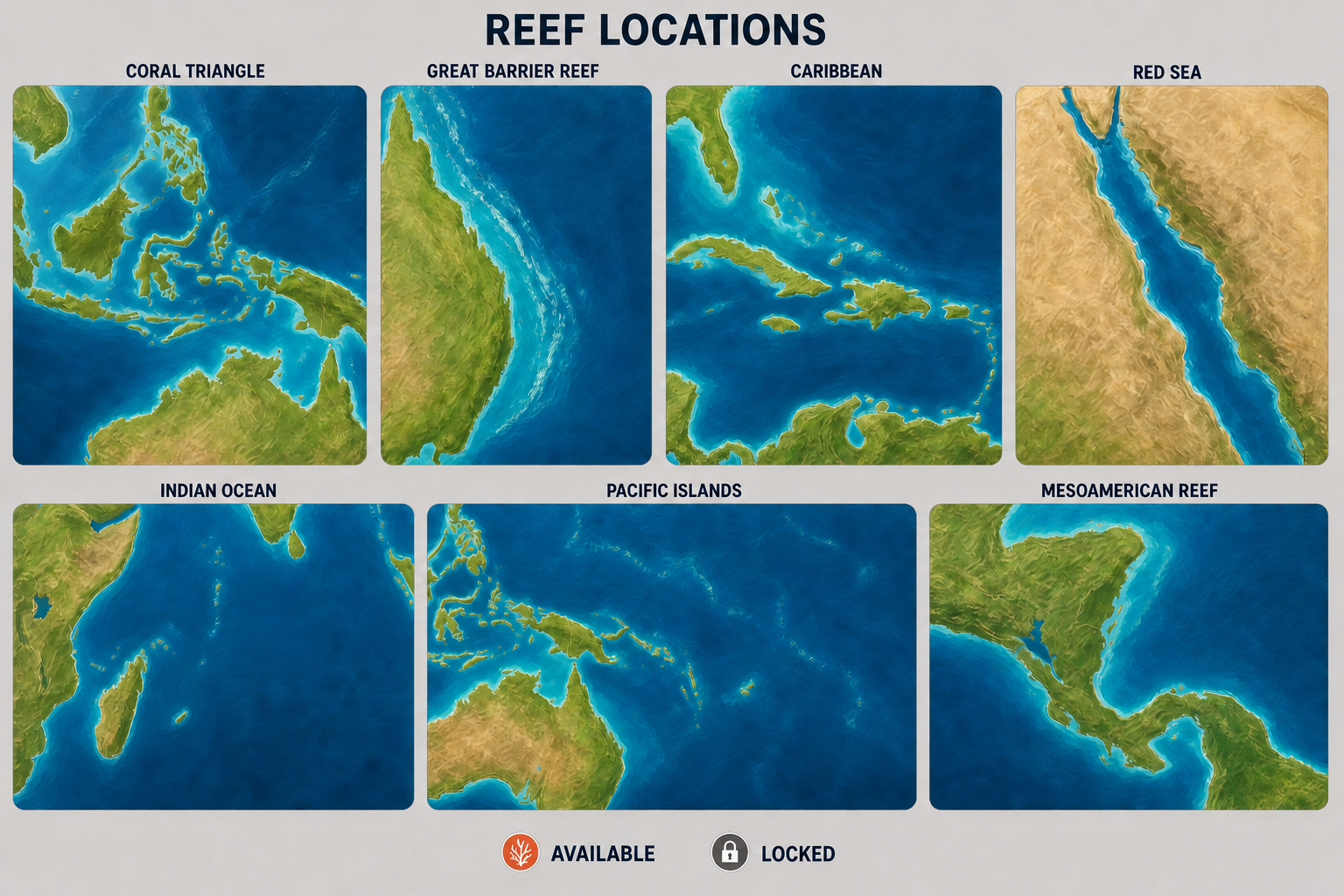
Outcome: A marker-free derivative of the approved regional artwork now sits beneath sharp interactive labels and pins. Target overflow is held outside the visible three-row area, treasure emerges through the available chest gap into safe bounds, and the completion route returns to the relevant dive map.
Polished
Map labels were made readable in every state
Prompt: Prevent nearby site names from colliding and keep locked-site names bright rather than dimming the whole marker.
Outcome: Interaction state was separated from label appearance, preserving solid white text for locked locations. Per-site placement resolved collisions in the Caribbean and the densest Great Barrier Reef cluster.
Defined
A minimal progression and reward model was approved
Prompt: Plan persistent site progression, Timed and Hard variants, medals, replay rewards, gem spending and region completion before implementation.
Outcome: The agreed loop starts with one available site, unlocks both Timed and Hard after Standard completion, advances through deliberately ordered destinations, grows Hard boards from 10×10 to 13×13, gives Standard replays one-third of the first reward, and uses Bubble Trails as the first cosmetic purchase.
Expanded
Seven regions gained a scalable content structure
Prompt: Provide at least five meaningful sites per region, move the offshore reef into an optional bonus expedition, and support local educational information while deferring external links.
Outcome: The catalogue now has at least five standard destinations in every region, locally authored region and site information, and a bonus-expedition model that does not block world progression. Player-facing external links remain deliberately deferred.
Delivered
Persistent progression, modes and rewards became playable
Prompt: Begin implementing the approved progression foundation and connect it to live campaigns, results and cosmetics.
Outcome: Site, region, gem, medal, score and cosmetic progress now persist. Standard completion unlocks travel plus Timed and Hard play, active-play timing excludes transitions and background time, Hard grows through 13×13, rewards cover first clears and replays, and Bubble Trails can be bought, equipped and seen during play.
Audited and optimised
Dedicated iOS audits drove Hard-mode performance fixes
Prompt: Use multiple iOS-focused reviews to identify structural and runtime risks, then address laggy long-word animation, capsule alignment, cramped grids and excessive edge placements.
Outcome: The review confirmed a sound overall architecture and identified broad update, node recreation and bubble-view costs. Follow-up work retained selection nodes, reduced status publishing, cached expensive artwork, centred glyphs and capsules on the same geometry, reclaimed horizontal space and chose the best of four valid layouts to minimise complete edge words.
Rebuilt
Bubble motion moved to one GPU-backed system
Prompt: Replace laggy long-word bubbles with a texture or shader approach, make level transitions use the same effect, and reuse it for the final treasure reveal.
Outcome: Reusable bubble textures now draw through one Canvas and one animation clock instead of dozens of independently animated views. Letters and their compact bubble clusters share deterministic paths and timing during score flights, incoming-level transitions and final-grid departure; the chest waits until every cluster clears.
Delivered
Replay-aware vocabulary gained a guaranteed-grid safety net
Prompt: Prototype a substantial site-specific dictionary, avoid repeating the same level word set on replay, make word reuse within one dive a last resort, and guarantee that every level always has a real grid.
Outcome: The first site now has separate curated 60-word Standard and Hard profiles. Standard and Timed share history, Hard remains separate, exact level sets cannot repeat on immediate replay, all unused eligible words are exhausted before reuse, and bounded dynamic generation is backed by two prevalidated fallback sets. A ten-level campaign cannot finish construction without all ten grids.
What improved
Improvements made.
Evidence-led changes grouped around the product, implementation, design and working process.
Crisp, maintainable regional-map overlays
Removing baked labels and pins from a derivative map sheet lets the interface draw sharp, accessible site controls independently of the illustrated geography.
Persistent world progression
Unlocks, completions, region state, results, currency and equipped cosmetics now survive relaunches and drive presentation rather than relying on fixed prototype states.
Three distinct play modes
Standard advances travel, Timed measures only interactive play and records medals, and Hard increases both vocabulary difficulty and grid dimensions through a 13×13 finale.
Meaningful reward loop
First clears, replays, medals, Hard completion, region completion and bonus expeditions award centrally defined gems, while Bubble Trails provide an immediate cosmetic use for the balance.
More readable and fair Hard boards
Tighter horizontal clearance gives letters more space, capsules share the glyph centre, and bounded layout comparison reduces whole words placed along straight outer edges.
One scalable bubble renderer
A consolidated texture-backed Canvas serves score flights, level transitions and the treasure reveal, reducing view hierarchy and keeping bubbles paired with their letters.
Fair selection across exposed layers
Visible next-level letters can now start and extend a selection, preventing position-based deduction, while any mixed-level candidate remains invalid for current targets and cannot mutate either grid.
Varied but dependable campaign generation
Versioned site vocabulary, deterministic replay history, bounded retries, least-used-word selection and prevalidated fallback sets provide variety without ever returning a missing level.
Pain points
Friction, constraints and open edges.
Resolved problems are separated from constraints and work that remains open.
Baked map controls looked pixelated and collided
The approved artwork included raster labels and pins that became soft at phone scale and could not adapt to neighbouring sites. A clean derivative plus live interface overlays resolved both sharpness and placement.
Overflow targets rendered over earlier capsules
An unplaced target could fall back into occupied flow space. The queue now renders only its measured three-row capacity and holds later targets outside the visible layout until room becomes available.
Long Hard-mode animations overwhelmed the view hierarchy
Long words could create around one hundred independently animated gradient-and-shadow bubble views, producing visible stalls and broken motion. A single Canvas, shared timing and cached specifications removed the main structural cost.
Letters, capsules and score flights used inconsistent centres
Glyph baselines and selection shapes did not share the same cell geometry, while random per-letter durations could leave characters stranded lower on the board. Canonical centres and one word-level duration restored alignment and coherent arrival order.
Exposed lower-level letters revealed hidden word information
Visible letters from the next layer could not begin a drag, allowing players to infer that no current word started there. They now behave like normal selectable cells but remain ineligible to complete current-level targets.
Replay variety conflicted with reliable grid construction
Strictly avoiding prior words can make difficult layouts impossible, while fixed fallbacks can repeat too early. Additional high-budget unused-word attempts now run before two prevalidated fallback variants provide the final safety guarantee.
Outputs & proof
What was delivered and verified.
Verification grew with the feature set: regional-map and gameplay refinements passed 70 checks; progression and modes reached 87; Hard-mode performance work reached 90; the Canvas and reward update reached 91; dynamic vocabulary and fallback coverage reached 100; lower-layer selection and transition bubbles reached 104; and the final reuse and treasure work ended with 107 passing checks and a successful simulator build.
Verification record
- Regional-map snapshots confirmed crisp live labels and pins, white locked-site names and collision-free placement across the available regions.
- Compact target-queue snapshots confirmed exactly three non-overlapping rows with later words withheld until space becomes available.
- Progression tests covered persistence, locked-mode protection, next-site and next-region travel, bonus-expedition unlocking, rewards and equipped cosmetics.
- Timed play tests confirmed that transitions, interruptions and background time are excluded from active-play duration.
- Hard-mode stress generation covered 10×10 through 13×13 layouts and the bounded best-of-four edge-word policy.
- Animation tests covered shared letter-and-bubble paths, deterministic word-flight timing, reduced-motion behaviour and delayed chest appearance until all final clusters clear.
- Vocabulary tests covered separate profiles and history, immediate replay non-repetition, multi-seed construction, forced fallback, least-used reuse and complete ten-grid campaigns.
- The completed interval passed 107 automated checks and a simulator build on the primary development device profile.
Key decisions
Only one site is available initially; Standard completion drives the authored travel route and unlocks both Timed and Hard for that site.
Every region contains at least five standard destinations, while optional bonus expeditions can unlock without blocking later travel.
Hard board sizes progress from 10×10 to 13×13, and physical small-device testing remains the acceptance standard for readability and performance.
Gems are the only counted currency for now, and Bubble Trails are the first purchasable cosmetic; visual treasure remains celebratory rather than a second economy.
Local educational descriptions ship before player-facing external links, which remain a future update.
Bubble textures in one shared Canvas are preferred over a per-bubble shader because the main bottleneck was view count rather than path calculation.
Campaign history is saved only after all levels generate successfully, preventing failed construction from consuming a replay combination.
Word reuse is permitted only after unused eligible vocabulary is exhausted; fixed layouts remain a final safety guarantee rather than the normal path.
Visual checkpoints
Generated and edited images.
The interval contains one generated visual asset: a marker-free derivative of the approved regional-map board. It preserves the seven illustrated geographies while removing baked site labels and pins so the app can draw crisp, state-aware controls at runtime. User-supplied recordings and screenshots are excluded because they served as review inputs.
Next moves & open questions
Current position.
The game now supports a persistent journey from one initial site through multi-site regions, optional bonus expeditions, three play modes, medals, replay rewards and cosmetic spending. Regional maps use clean artwork beneath crisp interactive overlays. Hard boards are larger but more readable and performant, bubble motion is consolidated across scoring, transitions and the treasure reveal, exposed lower layers no longer leak word information, and the first site-specific vocabulary system provides replay variety while guaranteeing every level. The latest build and all 107 automated checks pass; the current changes remain ready for device playtesting and the normal project publication workflow.