Interval
Work since the previous summary
This interval moved from a detailed audit of the existing vocabulary through runtime integration and then into presentation and flow refinements. Prompts progressively tightened the brief: first around geographic relevance and difficulty, then replay variety and performance, then grid quality, map readability, launch polish, and preserving the player’s place in the equipment room.
Direction of travel
How the work evolved.
Each step connects the user’s prompt to the practical change it produced.
Redesigned
Rebuilt the vocabulary around every dive site
Prompt: Classify words independently by geographic scope and difficulty, give each site a substantial viable pool, minimise overlap, control variants, and test repeated play across multiple sites.
Outcome: The audit revealed 36 sites rather than the smaller assumed set. A 250-word master pool was created for each site, producing 9,000 assignments with a 54.8% easy, 30.0% medium, and 15.2% hard mix. The worst same-reef pair shared only four words, or 1.6%.
Integrated
Moved the new catalogue into live gameplay
Prompt: Integrate the redesigned pool into the app instead of leaving it as a separate audit artefact.
Outcome: Standard, Timed, and Hard play now derive progressively weighted selections from one master pool per site. The bundled catalogue contains scope, difficulty, family, and rationale metadata, with lazy per-site loading and caching to keep normal access responsive.
Refined
Made replay variety realistic and measurable
Prompt: Keep repeated campaigns fresh and prevent Hard play from simply repeating Standard vocabulary.
Outcome: Selection now avoids recently used Standard words for Hard play wherever the constraints allow. Testing showed that a completely disjoint second Standard campaign would conflict with required word-length and grid constraints, so the implementation replaces 35 of 81 words and relocates unavoidable repeats between levels instead of promising impossible separation.
Improved
Strengthened grids, maps, and globe labels
Prompt: Fix overlapping reef-map labels, improve globe-label contrast, make replacement letters safe after clears, prevent one answer sitting entirely inside another, and increase intersections and direction variety.
Outcome: Marker and label placement is now collision-aware, globe labels have stronger backing, cleared cells receive letters that cannot reveal the next target or accidentally form a word, contained target paths are rejected, and layout ranking rewards intersections and directional variety.
Polished
Added a branded launch and preserved room context
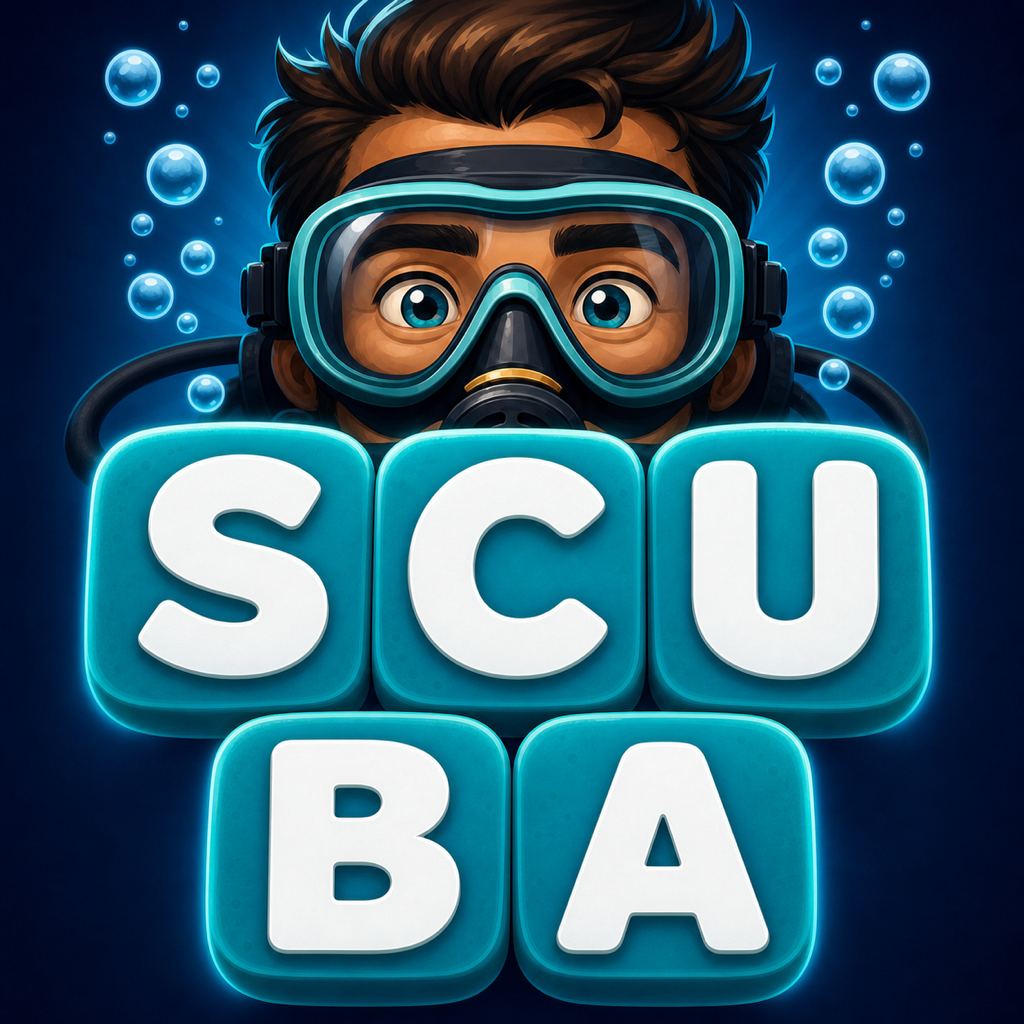
Prompt: Start with the app icon, animate the diver and letters away, and return players from the safe or posters to the area they had been viewing rather than the computer.
Outcome: A native launch screen now hands off to an in-app diver-and-letter animation, with a short fade for Reduced Motion. Equipment-room navigation preserves the player’s prior focus when returning from close-up views.
Consolidated
Brought the verified work together
Prompt: Consolidate all completed changes into the shared product state.
Outcome: The vocabulary, gameplay, presentation, launch, documentation, and review-only artwork changes were brought together and synchronized. Private delivery details are intentionally omitted from this record.
What improved
Improvements made.
Evidence-led changes grouped around the product, implementation, design and working process.
More relevant, less repetitive site vocabulary
Each of the 36 sites now has a 250-word pool, while scope and difficulty remain independent. More than half the assignments are easy enough to support early progression, and overlap between nearby sites is tightly controlled.
Faster catalogue access
Focused loading and caching reduced normal catalogue access from roughly 13 seconds to about 0.32 seconds. Redundant fallback calculation, repeated sorting, and unnecessary text normalisation were removed from the hot path.
Stronger grid construction
Target containment is forbidden, layout ranking favours intersections and varied directions, and isolated vertical placements are discouraged. Replacement cells also avoid leaking the next answer or creating accidental words.
Clearer geographic presentation
Reef-map labels and markers are placed with collision awareness, while globe labels use brighter treatment and dark backing for more reliable contrast.
More coherent navigation and launch flow
The branded launch transitions from the familiar app icon into the game, and close-up equipment-room interactions now return the player to the context they came from.
Reviewable art direction
A globe-on-monitor equipment-room variation was generated as a separate approval asset. The live room remains unchanged until that visual direction is explicitly accepted.
Pain points
Friction, constraints and open edges.
Resolved problems are separated from constraints and work that remains open.
The source structure was larger than expected
The supplied catalogue represented 36 sites across seven reefs, not the smaller site set implied by the initial framing. The redesign had to scale while preserving the existing limit on how many site pools could share one word.
Line endings initially hid the catalogue
A parser treated the entire imported file as one header because of its line-ending format. Normalising input handling restored the complete 9,000-assignment catalogue.
Eager validation made access too slow
Validating and rebuilding every site on routine catalogue access took about 13 seconds. Loading only the requested site and caching the result brought the focused path down to about 0.32 seconds.
Perfectly disjoint replay is not always possible
The required mix of short and long words, combined with grid construction constraints, prevents a fully distinct second Standard campaign. The delivered approach maximises replacement and shifts unavoidable repeats between levels.
The latest interface refinements still need a live pass
The final map, grid, launch, and room-return changes compiled successfully, but no simulator was available for a last visual and interaction check during those refinements.
Outputs & proof
What was delivered and verified.
The vocabulary redesign was exercised at scale and the integrated catalogue was checked through automated and development flows. Later interface refinements have compile-level evidence, with a focused live visual pass still outstanding.
Verification record
- All 12 vocabulary acceptance checks passed with no errors or warnings.
- A 3,000-session mixed-site simulation recorded average repeated words of about 0.045%, with no Hard-mode repeats in the tested sessions.
- The integrated catalogue matched its expected checksum and all 9,000 assignments were available across 36 sites.
- All 144 unit tests passed after catalogue integration.
- A development interface test passed and the app launched successfully after the catalogue work.
- The later map, grid, launch, and navigation changes compiled for both app and test targets.
Key decisions
Use one 250-word master pool per site and derive game-mode selections at runtime, rather than maintain separate hard-coded Standard and Hard lists.
Store geographic scope and difficulty as independent metadata so relevance does not dictate challenge level.
Load and cache individual site pools on demand, keeping full cross-site checks available without making routine access pay their full cost.
Optimise replay variety within actual grid constraints instead of claiming complete separation that the available word-length mix cannot support.
Generate safe random replacement letters after clears so they neither expose the next target nor create an unintended word.
Keep the globe-on-monitor room variation review-only until it is approved for the live experience.
Use a static native launch screen followed by the app animation, with a reduced-motion fade for accessibility.
Visual checkpoints
Generated and edited images.
Two visual artefacts capture the presentation direction explored in this interval: the proposed equipment-room monitor treatment and the icon used to anchor the new launch experience. Both are stored beside this page as portable companion files.

Next moves & open questions
Current position.
The 36-site vocabulary system and its gameplay selection logic are integrated, tested, and synchronized. Grid quality, map readability, launch presentation, and room-return behaviour have also been implemented and compile cleanly. The remaining work is a focused live visual pass and a decision on whether the proposed globe-screen room art should replace the current version.