Interval
From roadmap clarity to a cleaner treasure payoff.
The work moved through four connected directions. It began with a practical audit of what remained, prioritising stability and performance before wider content and release work. A new chest-opening reference was then generated, approved, converted into transparent production artwork and integrated as a slower, grounded reveal. The final feedback removed the extra gem-scattering layer, leaving the most legible and satisfying frame as the lasting result.
Direction of travel
How the work evolved.
Each step connects the user’s prompt to the practical change it produced.
Prioritised
Turn the remaining work into an actionable route
Prompt: Clarify what is still left to do and identify the most valuable next batch.
Outcome: The remaining work was grouped into stability, performance, device validation, content and release readiness. Three immediate stability risks were placed ahead of broader expansion so the next development pass has a clear focus.
Created
Design a six-stage treasure reveal
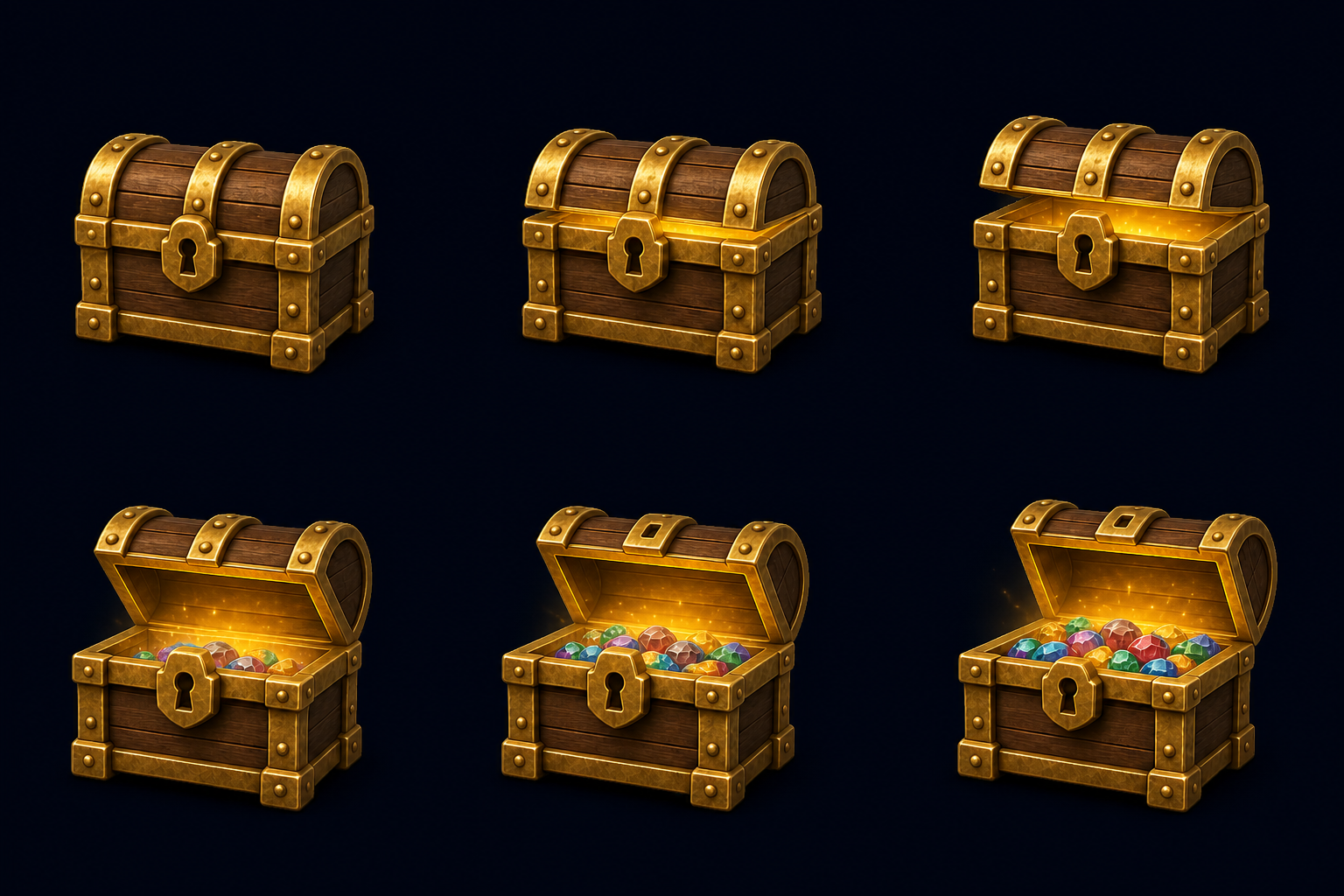
Prompt: Create a new sequence that moves from a closed chest through a slow lid opening, growing light and a final chest full of colourful gems.
Outcome: A single coherent concept sheet established the full progression. It preserved the approved chest design while making the light and gem reveal progressively more prominent across six readable stages.
Integrated
Convert the approved concept into production animation
Prompt: Use the new reference to replace the existing treasure animation in the game.
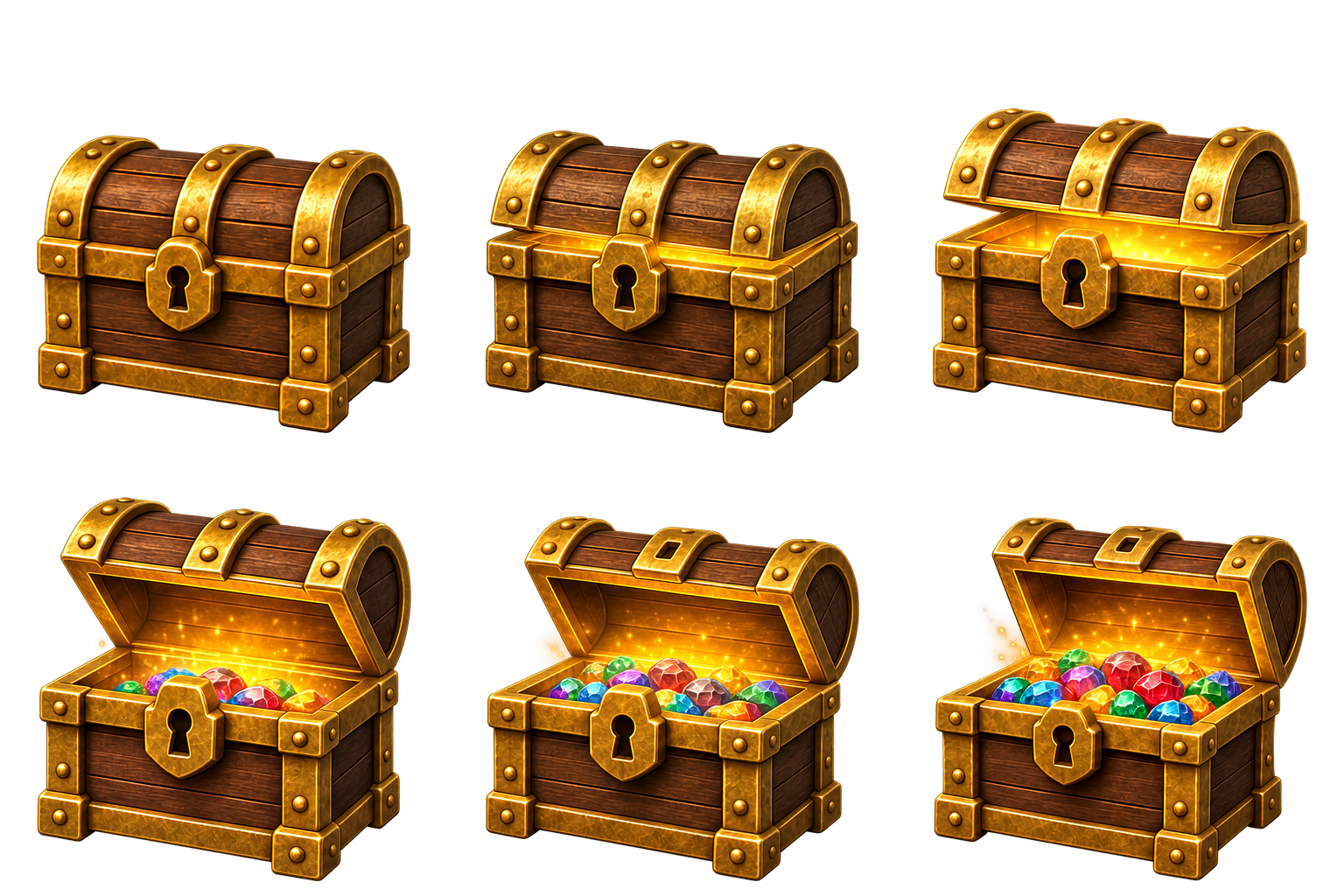
Outcome: Six transparent, identically sized frames were aligned to a fixed seabed baseline and wired into a 1.52-second lid-opening sequence. The chest body stays grounded while the lid, interior glow and gems advance frame by frame.
Refined
End on the open, gem-filled chest
Prompt: Stop the reveal at the fully open chest and remove the additional gems scattered around it.
Outcome: The separate reward-gem elements and their launch, landing and scattering behaviour were removed. The open chest is now the final visual state, followed by a short hold before the return action appears.
What improved
Improvements made.
Evidence-led changes grouped around the product, implementation, design and working process.
A more coherent opening motion
All six frames use the same square canvas and fixed baseline, so the chest reads as one object opening in place rather than a sequence of differently positioned illustrations.
A deliberately paced reveal
The lid opening now develops over 1.52 seconds, allowing the latch release, early glow and final gemstone reveal to register as distinct moments.
Light and reward build together
Warm interior light increases as the lid opens, while the final stages introduce a colourful gem collection inside the chest without adding coins or unrelated reward objects.
A cleaner final composition
Removing separate airborne and scattered gems keeps attention on the strongest asset: the fully open chest filled with gems. The return action now appears after this final frame has had time to settle.
Normal and reduced-motion paths agree
Both presentation modes now finish without external reward sprites, preventing the simplified endpoint from diverging for players who use reduced motion.
Design intent and implementation stay aligned
The written requirements were updated alongside the production behaviour so future work has one consistent description of timing, visuals and the final state.
Pain points
Friction, constraints and open edges.
Resolved problems are separated from constraints and work that remains open.
The first transparency pass was not true transparency
An early export contained a visible checkerboard instead of a real alpha channel. That pass was rejected and replaced with genuine transparent artwork before integration.
Generated edges needed production cleanup
Several converted frames carried coloured fringe artefacts around their silhouettes. The assets were cleaned and rechecked before being used in the sequence.
The final simulator service was temporarily unavailable
The final no-scatter revision could not use the usual live simulator capture path. A rendered interface attachment and focused automated checks provided the final visual and behavioural evidence instead.
Stability and performance work remains
The roadmap still identifies rapid repeated starts, background preparation control, save recovery and several rendering or memory costs as the most important engineering work before wider release preparation.
Outputs & proof
What was delivered and verified.
The production sequence and the later simplified endpoint were both checked against focused behaviour tests. The complete opening transition was also observed in a current large-screen simulator before the final reward-sprite removal, and the ending was then verified from a rendered interface attachment.
Verification record
- All 10 focused treasure-reveal checks passed after the six-frame animation was integrated.
- The complete closed-to-open transition was observed in a current large-screen phone simulator.
- All 10 focused checks passed again after the separate gem animation was removed.
- Normal and reduced-motion coverage both confirmed that no external reward sprites remain.
- A rendered final-state attachment showed the open gem-filled chest without scattered gems.
Key decisions
Keep the established chest design as the visual source of truth while expanding it into a staged reveal.
Use six identical 512-by-512 transparent canvases so only the intended lid, glow and gem changes create motion.
Reject simulated checkerboard transparency and require a real alpha channel for production artwork.
Make the open gem-filled chest the final state and remove the secondary reward-gem animation entirely.
Show the return action only after a brief hold on the final frame.
Prioritise stability and performance before broadening content and release work.
Visual checkpoints
Generated and edited images.
The gallery preserves the generated design progression and the production-ready animation set. It begins with the original six-stage concept, follows with the transparent production sequence, and then presents each aligned runtime frame from closed chest to the final gem-filled state.






Next moves & open questions
Current position.
The treasure reveal is now a tested six-frame animation whose endpoint has been deliberately simplified. The next recommended development batch is the previously identified stability and performance work, followed by physical-device validation and then broader content and release preparation.