
The problem
Road Speed Calibrator began with a practical rural concern: how can ordinary roadside video help document vehicles that appear to be travelling too quickly while retaining enough evidence for someone to review the estimate?
The goal was not to create certified enforcement equipment. It was to produce indicative results that make their inputs and reasoning visible instead of presenting an unexplained number.
What the app does
The iOS app records or imports roadside video. The user identifies a calibrated area of road and supplies a known width, allowing image positions to be projected onto a top-down road plane.
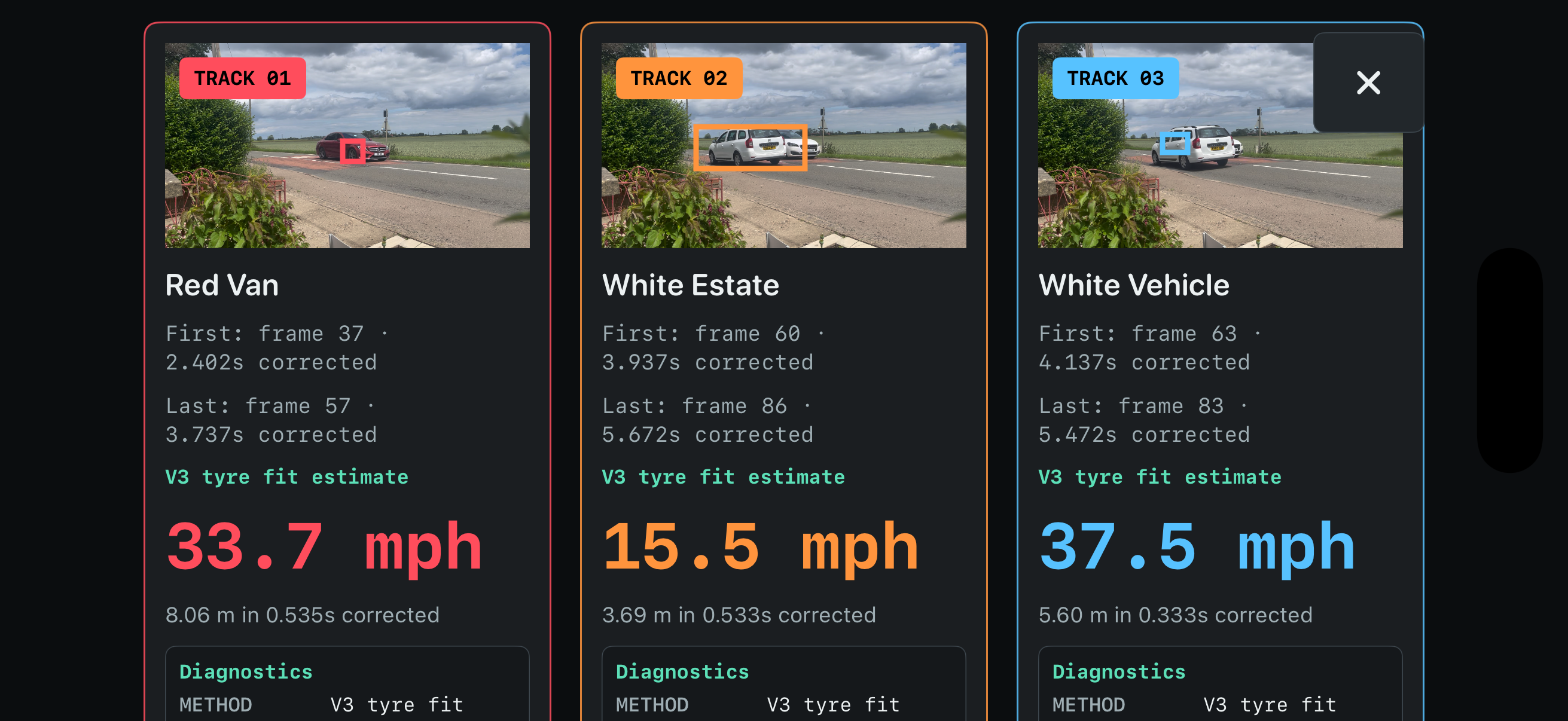
Vehicles are tracked frame by frame using Vision and Core ML. The app uses actual video frame timestamps rather than assuming every frame arrived at a perfect fixed interval, then combines time and calibrated distance to estimate speed.
- High-frame-rate video recording and import
- Road-plane calibration with a top-down perspective view
- Vehicle tracking, wheel-position guidance and contact trails
- Calculation summaries and evidence export
Engineering challenges
Video timestamps can vary, perspective distorts apparent distance, and a vehicle’s visible bounding box does not directly identify where its tyres contact the road. Tracking also needs to remain stable as vehicles change scale, overlap or leave the frame.
The product therefore distinguishes measured data, estimated contact points and guidance overlays. Calibration remains visible and editable, while results retain the information needed to understand how an estimate was produced.
Built with Codex during OpenAI Build Week
I conceived the product, defined its measurement approach and made the key engineering, safety and design decisions. Codex with GPT-5.6 acted as an engineering collaborator throughout the SwiftUI implementation, helping extend the codebase, explore edge cases, create regression tests and verify behaviour in the simulator.
The collaboration accelerated delivery while keeping responsibility for the calibration model, constraints and final code with me. The result progressed from an idea to a working iOS product with video analysis, calibration, trails and evidence export.
Watch the app in action
The video demonstration follows Road Speed Calibrator through its working flow, showing how roadside footage is analysed, calibrated and turned into reviewable vehicle-speed results.
Technology
Swift, SwiftUI, AVFoundation, AVKit, Vision, Core ML, Core Image, MapKit and XCTest, supported by Codex and GPT-5.6.